Friday, 1 May 2026

Nothing and Everything All At Once

 Hi! Hello! I'm here! I'm just lazy. 

 Let's talk Singapore.

Singapore was only on my radar because of the airport. That and it is an entire country and a city at once. So I didn't know what to expect. 

I only ended up in Singapore because I was ghosted by a travel colleague who was helping me plan a cruise. I needed to go somewhere and Singapore is somewhere!

I had a few concerns. What if I don't speak the language? What is the language? Is it really as expensive as everyone says? What if I inadvertently run afoul of the law and end up getting caned?

 So I went to Singapore. They speak many languages there but everyone speaks English. It's only expensive if you want it to be. I left my gum at home so I wasn't caned.

 I walked. A lot. Four days of a lot of walking. And it was hot. And humid.

 After dropping off my bags at the hotel, I set out to find something I've never been in before: a Buddhist temple. No real reason I haven't been in one other than not having the opportunity.

I went to the Buddha Tooth Relic Temple and Museum. When you first get in, if you're not appropriately covered - no shorts - they will give you a sarong to cover your legs, regardless of gender.


 On the day I went, I was only able to access the first level of this building and that is enough. It is an active place of worship. There were monks in there doing monk things! 

Along the walls of this temple are literally thousands of Buddha statues of various sizes. There are eight main ones which are all part of the Buddhist zodiac.


 Each of these smaller idols has a number. On the counters below, there are guides to find the numbers. People and families can purchase the statues for varying from $500 for a smaller idol to the millions for a larger idol. According to the nice man who worked there answering questions, the more you pay the more devout you are.


 At the front of the temple is an alter to Buddha Maitryea, with two bodhisattvas on each side. 


 The place is very quiet. American tourists are quickly shushed. Occasionally you can hear the tingling of bells. It smells like incense. There are vending machines at the doors where you can buy these jelly food things that look like other food. Apparently these are offerings and are edible; in the past, people would bring in real food, but that would attract bugs and rodents. 

 There are many alters and idols with different purposes and meanings. People were praying or gesturing at most of them so I did not want to disturb them with my questions or camera. 


As you exit out of this temple, there is one last alter. There are candles available for purchase to devotees. I was struck by how Catholic this looked.

 Next on the "why not more places of worship?" walk was the Thian Hock Keng temple, a Taoist temple. I've been in one or two Taoist temples before but I'm always interested to see more. Besides, this translates to "The Temple of Heavenly Happiness" and who can't use more of that in their lives?

I mentioned above that Singapore is hot and humid. This affects building design. Thian Hock Keng is open air, meaning that it has no meaningful roof over most of it's space.

Once you are through the doors, you enter into a main courtyard area that they kindly ask you not to take pictures of. In my effort not to get caned, I only took pictures in places I was allowed.


Mostly in the covered walkways between spaces. Which were breathtaking.

As you make your way through this temple, there is a clear and distinct path you are to follow. This path teaches you about different aspects of Taoism. At the end of this path there are wishing bells you are allowed to ring. The bells represent health, success, and prosperity. You're allowed to ring one or all of them.


                                                   Lotus lanterns that were gently swaying in the light breeze.
     

I made my way along to the Sri Mariamman Temple, Singapore's oldest Hindu temple. Again, I've never been in a Hindu temple so this was an interesting experience.

Along the outside, there are colourful and detailed carvings of many Hindu deities, cultural figures, and exotic beasts, culminating in a five floored gopuram.


This is also an open air space and an active place of worship. Once you enter, it is required to take off your shoes and don a sarong. I went from wearing zero skirts for 20 plus years to two in one day. Very strange and had to do some quick reconciliation with my feelings; wearing a skirt is not natural for me and it does not look good. It did not make me feel good but I was willing to get past it for the experience.

The temple was still set up for Deepavali, the Festival of Lights, though it had ended a day or two before. There were still beautiful flower arrangements everywhere.

I'm told this is Sri Mariamman, the main Tamil goddess. She is a protector from disease and a bringer of rain and prosperity.

 Next up: things you think of when you hear Singapore


Thursday, 21 November 2024

I'm another world away but I always feel at home

 As you are driving along the highways and byways of Portugal, you see trees with numbers painted on them. Some of the numbers are more vibrant, some are more faded. Trees with more faded numbers have nearly black bark. Trees with much lighter bark have much more vibrant are more of a reddish pink to grey colour. Some trees have no numbers at all. It is a curious thing but our guide chooses not to explain it, telling us we will all understand in a few days. Frustrating, but okay.

On my actual birthday, we are on a cork farm just outside of Évora. This has been referred to as a "cork farm" in all the literature and each time it is referenced by our guide. I don't know anything about cork other than its use in wine bottles, shoe, and trivets. Maybe it floats? I think it floats but it is not tenable to build a boat out of it. But we are going to a cork farm to find out how cork is grown and made and manufactured.

First thing we learn is that cork comes from trees. It is tree bark. Specifically it comes from cork oaks that are very finicky and don't grow just because you plant them. In fact, if you plant a line of cork trees in order to make a cork farm in some kind of orderly fashion, the trees will die off before they can be harvested just to spite you. You have to just let the trees propagate where they propagate and hope you get a good harvest eventually.

Second thing we learn is that it takes 25 years for a cork tree to grow enough bark to harvest. The first harvest is almost always the lowest grade of cork possible and goes into the making of thin cork products like wallets and purses and other trinkets. It is pressed together with the bark from other sub-par cork trees and maybe can be used for cheap cork things. This usually lasts two harvests. There are typically between 9 and 12 years between harvests.


The trees are then painted with the last digit of the year they were harvested. Older trees have darker bark. 


Trees harvested more recently have newer bark. Fresh harvested trees area reddish pink.

We were introduced to Big Mama, a 100+ year old tree that was the reason the founders decided to farm cork.

All of the bark is never stripped away. Doing so would harm the tree and as these are spiteful trees, no one wants to harm them.


                                                                          More cork trees.

As cork is a once a decade harvest, most cork farms are also vineyards. The owner of this vineyard is about my age. They also went to my high school at the same time I did. As soon as we met him I knew who he was. Do you think I can remember his name or did anything like take a picture of him? No. I did not. But it was neat to see someone I went to high school with in Portugal.


We went for a bit of a four by four tour of the vineyard and cork farm. We learned that Iberian ham is reared on cork acorns; the Spanish farmers will send in wee pigs at the beginning of the season, the pigs will eat tons and tons (literally) of acorns, and the cork farmers will be paid based on how much weight the pigs gained. This is very lucrative. The pigs were gone by the time we got there.

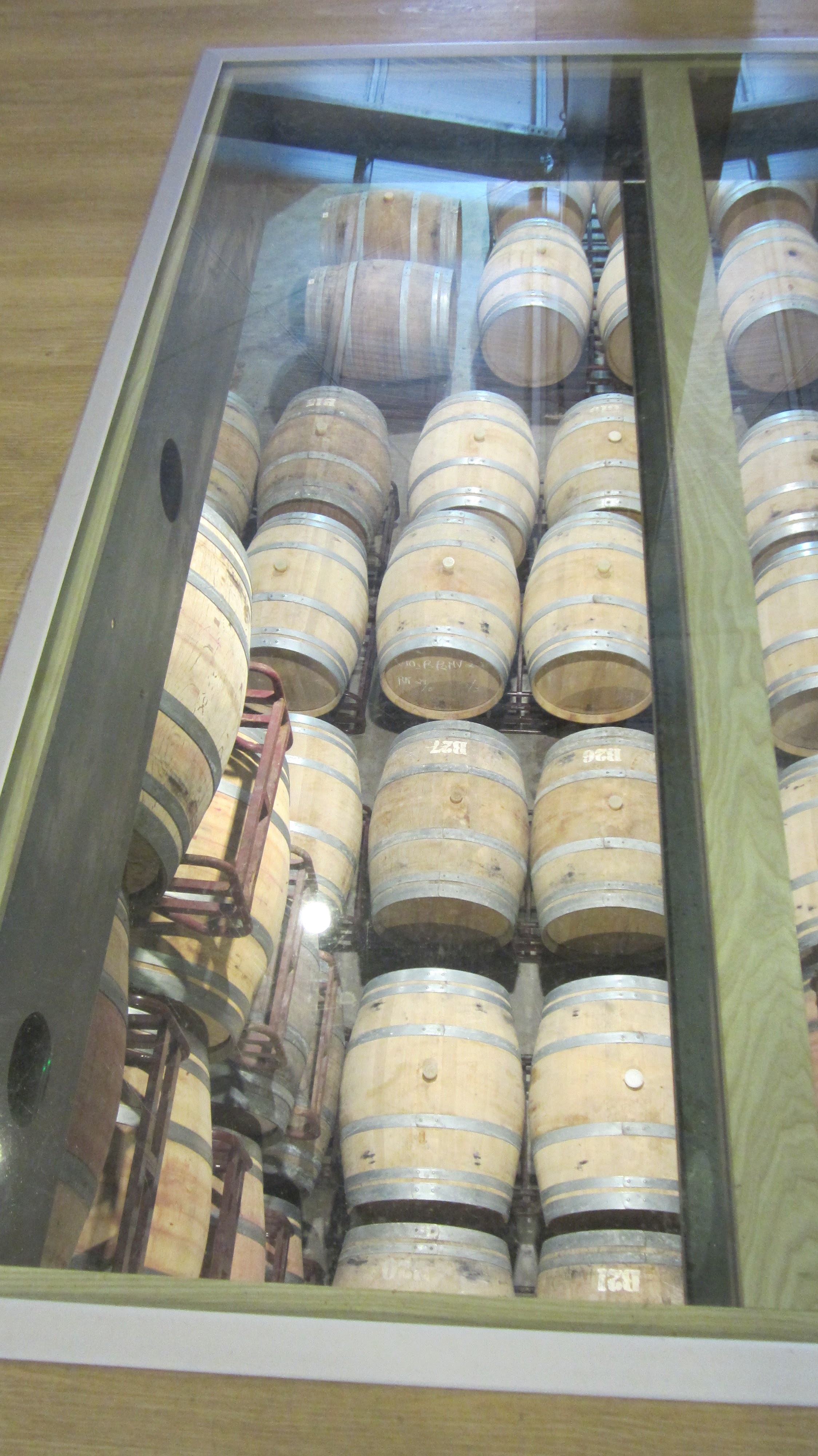
This particular farm had a cork and wine interpretive centre (for lack of a better word). It is very clear when walking through the main building that it is an active, working winery. This is on a catwalk to a loft. Despite my connection with the owner of the farm and the fact it was my birthday, I wasn't allowed into the room armed with a barrel drill and a straw.

The rest of the day was spent walking around Évora.


Next: I think the word "most" is doing a lot of heavy lifting.


Monday, 18 November 2024

Through my trials and tribulations, and my travels through the nations

Évora is a city that has been constantly occupied since the 6th century BCE. As a result, it has seen many occupiers who have left their mark. As it is in most cases, the mark that lasted was the Romans.


Not a folly. This what remains of the Roman Temple of Évora. It is falsely called the Temple of Diana after the goddess of the moon, chastity, and the hunt. It was originally built to honour and worship Agustus in the first century BCE. It has since been destroyed and rebuilt countless times and it is unlikely that any part of the original is in this structure. It has been used by Greeks to honour Zeus, as a centre for politics, and now stands in the middle of the UNESCO World Heritage Site of Évora.

Of course, there are many cathedrals within the city. At some point they all begin to bled together so I will focus on Cathedral Évora because the stories are more interesting. 

Most cathedrals are Roman Catholic and this one is no exception. The main way to tell is that everything in it is elaborate and covered in gold - Protestants were much uncomplicated. Less concerned with spending money to prove their faith. The upside is that Catholic churches are usually more beautiful to look at in terms of art and statuary and so forth. 

A lot of Catholic art is the same. There isn't a lot of variation because deviation from the norm is heresy and there aren't enough hail Marys in the world to come back from that. Most heretic art is destroyed or hidden away. We never learn of it because victors write history. This church is not a place for victors.

 As with any Catholic church, there is a depiction of the Virgin Mary. What makes Évora's Mary stand out is....well....


She's pregnant! There are incredibly few pregnant Madonnas in the world and I count myself lucky to have seen one. There was also another pregnant Madonna whose stomach opens to show a triptych of her life, but it was in a museum you had to pay to enter and Matthew 21:12-13 shows us that Jesus isn't so kind to people who change money inside a church. So I'm not about to take my chances.

What follows is one of my favourite travel stories. It might anger some people so if you're religious and easily offended maybe skip it. Or read it and have your delicate sensibilities challenged. Your call.

Some time between the 15th and 18th centuries, an artist was commissioned to paint a fresco for the church. Their name and the date are lost to time because people are uptight. The fresco they painted depicted Jesus baptizing Mary Magdalene. A woman. Pearls were clutched and gasps abounded and people probably died from shock. The elders of the church - who commissioned the painting in the first place - saw that the congregation lost their ever loving minds, decided that this must be destroyed immediately and the artist must give them back their money. The artist instead offered to "fix" the work to be a much more traditional John the Baptist baptizing Jesus. The church agreed and the artist came up with this:

Trans Jesus. The artist covered up Mary Magdalene's womanly bits with a cloth over her womanly hips and thighs, kept her crossed arms over her womanly boobs, and added a beard. Thus creating Trans Jesus. Slight alterations were made to Jesus to turn him in to John the Baptist as well. I guess Trans Jesus was okay bu the church because Trans Jesus is till around today. 

There are many other beautiful parts of this church including cloisters. These are typical of most cathedrals that have cloisters and are not all that worthy of being in a subversive art post. Quite frankly, the star of this show is Trans Jesus.

I'll close out on something I found interesting. I've been in countless churches of various religions around the world. Most religions have an aspect to them where you can light a candle for some reason. These are typically physical candles with wicks and wax and flames. The effect is very beautiful, very spiritual and peaceful. it's also kind of expensive and wasteful; people typically pay about 50 cents to $1 per candle and that doesn't cover the cost of the candles. When the candles are burnt out, they're not reused in any way (that I know of). Plus the soot from the smoke when extinguished isn't much from just one candle, but over time with thousands of candles it builds up. Also fire is a real thing that is really bad.


Instead, Cathedral Évora offers LED candles. For €1, you can buy a candle under many of the statues and in the shrines or at the nave. I don't know how long they're illuminated for. I thought this was pretty innovative and noteworthy. I don't know if it is commonplace but I haven't seen it before or since.

Next: actual birthday.


Saturday, 16 November 2024

Wind Up on the Very Same Pile

 Nos ossos qve aqvi estamos pelos vossos esparamos

We move on to Évora. Évora is an ancient, walled city that in many ways reminds me of Calgary. 

See, for many years - decades - Calgary tried to build a ring road. Construction and funding and being a resource-based economy all being what they are, the ring roads would be built, then massive neighbourhoods would spring up on the other side, causing the need for another ring road to be built around the new area a few years later. Calgary was eventually successful in building a ring road around the city, though time will tell how long it lasts.

Évora is similar in that the city was initially founded as a Roman settlement, so the Romans built a wall. The wall is high and slanted, which gave the hot oil the poured down it to fight off invaders a better chance.

Most of the city is encased in either the Roman wall or the "new wall" which was built in medieval times after the city grew around the perimeter of the Roman wall. The more modern version of the walls came much, much more recently in the form of highways.

Inside the walls lies a robust city with tiled streets. It is all on a hill so you really get a work out in! 


Something that is important to know about me is that I cannot count. I'm very bad at it and I am okay with this fact about me. This is worth mentioning because I thought Évora would be on my birthday and I could accomplish a travel goal: visit an ossuary. 

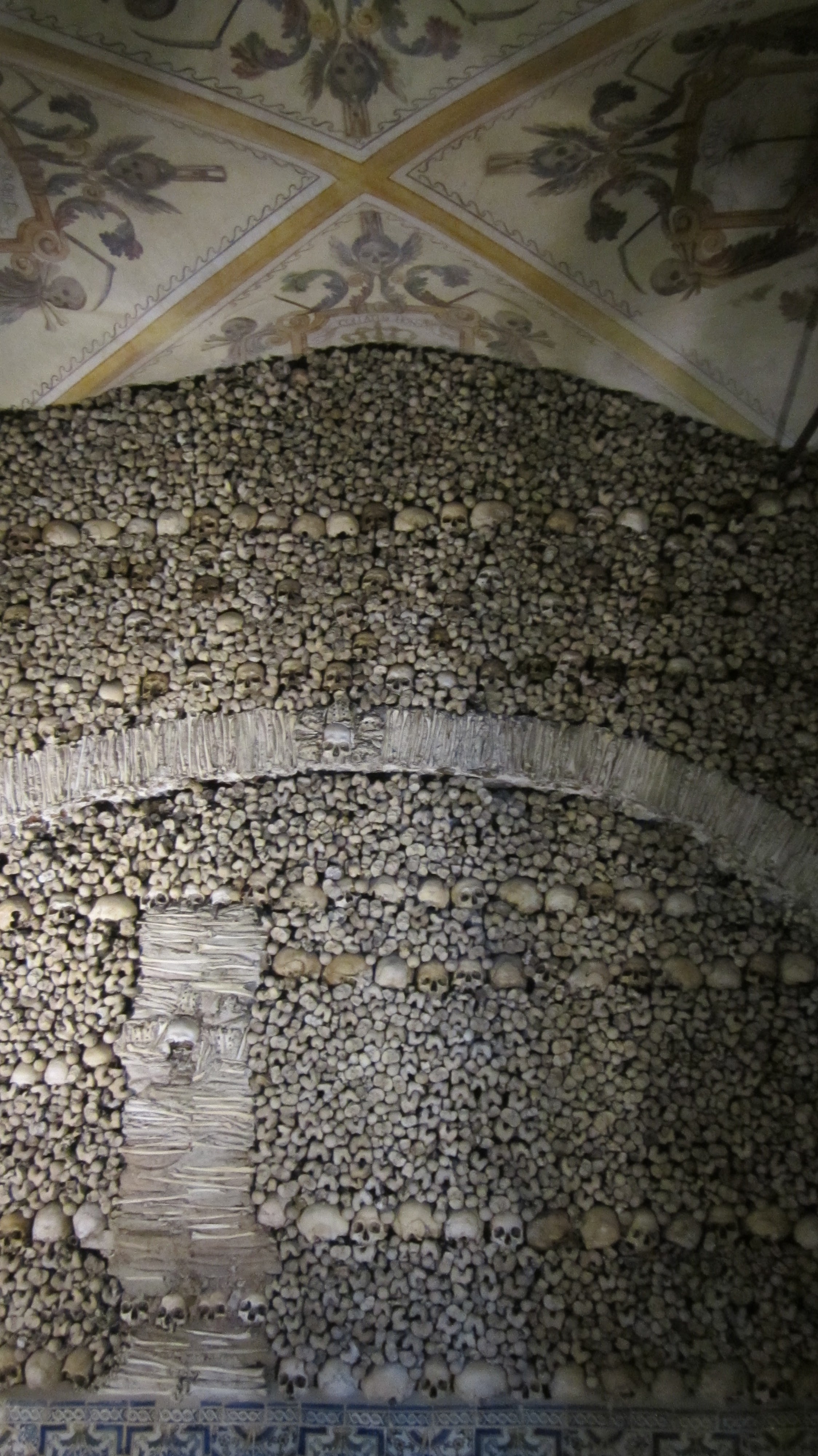
An ossuary is a temple made of bones. They can be built for many different reasons from the pragmatic to the religious to the morbid. Évora's ossuary falls into the pragmatic category. How could it be pragmatic, you ask? Well, there was a plague and a lot of people died, and they were running out of space so they relocated the bones of the dead to this chapel, thus creating an ossuary.

And I thought, what a profound way to spend my birthday: reflecting on life and the remnants thereof.

Except we were in Évora the day before my birthday. 

Still profound.

                                                        We bones that are here, for yours we wait


The monks who created the ossuary did so to create a final resting place of respect and dignity for the over 5,000 people here. Otherwise their remains would have been dug up and discarded or buried over. 

The space isn't large at all and as soon as you are in it, you are struck silent. First as your brain reconciles what it is seeing, then by the awe of the room. It isn't a place you want to go touching things or going off the marked path. You also don't spend a long time in this room because it's all a bit much.

Next: subversive art and 2023 collide in one church.


Friday, 8 December 2023

And now, Bad Joke Friday

 Bad Joke Friday started a few years ago as a thing a friend and I did within our group at work. The concept isn't that hard to grasp - tell a bad joke on Friday. Not exactly a difficult concept to grasp. People would still be upset when the jokes were bad, but it's in the name. They were warned.

We've both moved on from that job but Bad Joke Friday continues. Each Friday I work, I share a bad joke with my group. Rarely have I ever had the chance for a Bad Joke Friday in real life - that's not to say I don't tell bad jokes on Fridays, but the opportunity to live in the moment with one rarely presents itself.

On Friday, we are in Sintra at the National Palace. As we discussed previously, it is all very into romanticism. This includes many gargoyles.


 This particular gargoyle is on the way out of the palace. 

"Why is there an alligator on the arch?" Someone in my group asked.

"Because it will see you later," I replied.


Bad Joke Friday. It does what it says on the tin.

Monday, 4 December 2023

I could show you secrets behind every closed door

 Sintra is a short drive from Lisbon. Sintra also introduces a theme that will run throughout the trip: romanticism. 

Romanticism was a movement in Europe that emphasized an idealistic version of the past, the individual, and nature. It used emotions to create nature - in that there were places specifically designed for you to be awed, to be terrified, to be spontaneous. Think along the lines of stumbling upon a mysterious bridge in the middle of the forest.


Couldn't you just imagine spotting a troll under this bridge? Or a mysterious knight walking across? Or a forlorn woman wandering and lost, needing your help? What Big Emotions on this Ancient Bridge! How authentic and natural!

Except it is not. This is called a folly. This is a bridge with no actual, practical purpose other than it looks good. There's no creek or river or gap it crosses. It's just a bridge on a path. 


A sun dappled bend in the path where you can hear nothing and everything? The silence of the absence of people for miles around but the cacophony of the forest teeming with life? The groan of the trees bending and swaying in the wind, the leaves rustling from the breeze, the birdsong echoing through the ills and into infinity? Nope. A folly. 

Our guide welcomes us to romanticism as a kind way of saying "walking through the forest and up hill at the same time." She says, "we are going to experience a bit of romanticism," before we climb up again. It's all good fun and experience a bit of romanticism becomes a running joke for the rest of the tour.


A palm tree?! In Portugal?! Yes! Also a folly. James is not a folly.

Sintra was initially created as a royal getaway. It hosted generations of the Portuguese Royal Family - right up to and including when it became a Republic. The Royal Family stayed here until the last of them died out. One of the many royals it hosted was King Consort Ferdinand, of the House of Saxe-Cobourg-Gotha. This was a European royal dynasty from 1826 to present to 1917. If you're asking yourself why Saxe-Cobourg-Gotha sounds familiar, I will take this moment to remind you that we pronounce it "Windsor" in English.

Ahem. As I was saying, Sintra. 

The Pena National Palace was the summer residence for countless Portuguese royals and their families over centuries. It is has many architectural styles, based on who the biggest trading partners/builders/most influential people were at the time. Primarily, the influences are neo-Gothic (romanticism again), neo-Manualine (romantic, no?), neo-Renessance (do I have to say it?), and neo-Islamic (or Moorish). 

There are so many styles because each generation that lived here had a different opinion on what it should look like.


The palace was built on a monestary and few original parts remain. The influence of the monastery remain strong, with many chapels and prayer rooms, each with beautiful stained glass.


Virgin Mary, St. Michael, King Ferdinant II holding Pena Palace in his hand, Prince Henry the Navigator

Pena Palace (and the Romanticism Theme Park surrounding it) was also very advanced for its time. The engineers were very smart and figured out pretty quickly that the people living there would need water. Fortunately, this place isn't all that far from the Atlantic Ocean! But you can't drink ocean water. So they figured out a way to collect rain water and other run off.


Fortunately for you, you can sit by the fountains and basins and sigh wistfully as you long and hope for the love you may have lost or are yet to find. This isn't a folly because it has an actual functional purpose. 


The tiles on this fountain were done in the Moorish style. That is to say, they were made of individual pieces of coloured tile, as opposed to one tile painted many colours. 

Next: I'm surrounded by these walls.