Friday, 2 June 2023

Magna Eterna

 I've struggled with posting this. I've started and deleted so many times. I've seen a lot of famous and spectacular and breathtaking things in the world, and they've all been special and exciting. They've all meant something in their own way. I cherish each of the memories I have of them.

But none of them are this. None of them are as meaningful and significant to me as Petra.

I grew up poor. We didn't have a lot. We did have a VCR and a VHS copy of Indiana Jones and the Last Crusade. We didn't get along as a family but we watched this movie. I have this movie memorized. I can tell you all of the trivia, all of the bloopers, all of the anarchisms, all of the minutiae of this movie. I can even tell you about the Pepsi commercial. To this day, if you want to absolutely kill my productivity, put this movie on. I will stop what I'm doing to watch it. 

I've never really thought about filming locations. I assume that most movies are filmed on sound stages and back lots and elaborate sets in Hollywood. I think it's really cool what talented artisans and pedants can do. I didn't think of the places Indiana Jones was filmed as "real" places, always assuming they were a sound stage. It wasn't until the internet came out that I learned not only is Petra real, but it's still around. To say it's been a life goal to visit is putting it kindly.

Now I am an adult and focused on things like making sure I get a good night's sleep because in the morning, I am going to Petra. I know I need to get sleep or I will be tired and grumpy and I don't want to ruin this experience for myself or anyone else. So I go to bed very early. We spend the night in Alexandretta Wadi Musa in the oddest hotel I've ever been in. Our room had a curtain along the back wall that opened up to an empty pool hall. The window opened to a half roof situation.

We got up before the first call to prayer. Our breakfast was at 0430 and we had to be on the road at 0530. Our guide told us we would thank him later as we would get to Petra for 0600 when gates open. We would have the whole place to ourselves because who wants to get up that early? 

James does.

Inside the park, our guide tells us how Petra has long been a gathering place for numerous cultures along the Silk Road. Primarily it was used by the Nabataeans as their capital and as a fortress. There are several spots where we can see how advanced their designs were, such as where they had two gutters - one to collect rain fall for drinking water, and one to divert sewage from the drinking water. I wasn't smart enough to get a picture of this.

Over the years, many cultures came through this area. This means many languages and many stories to be told and many wheels being needlessly reinvented. Somewhere along the line, someone started carving dioramas into the rocks so people didn't have to start over again. For instance, this carving beside a large open area, depicting that it's a good place to let your camels rest.

And your James'.

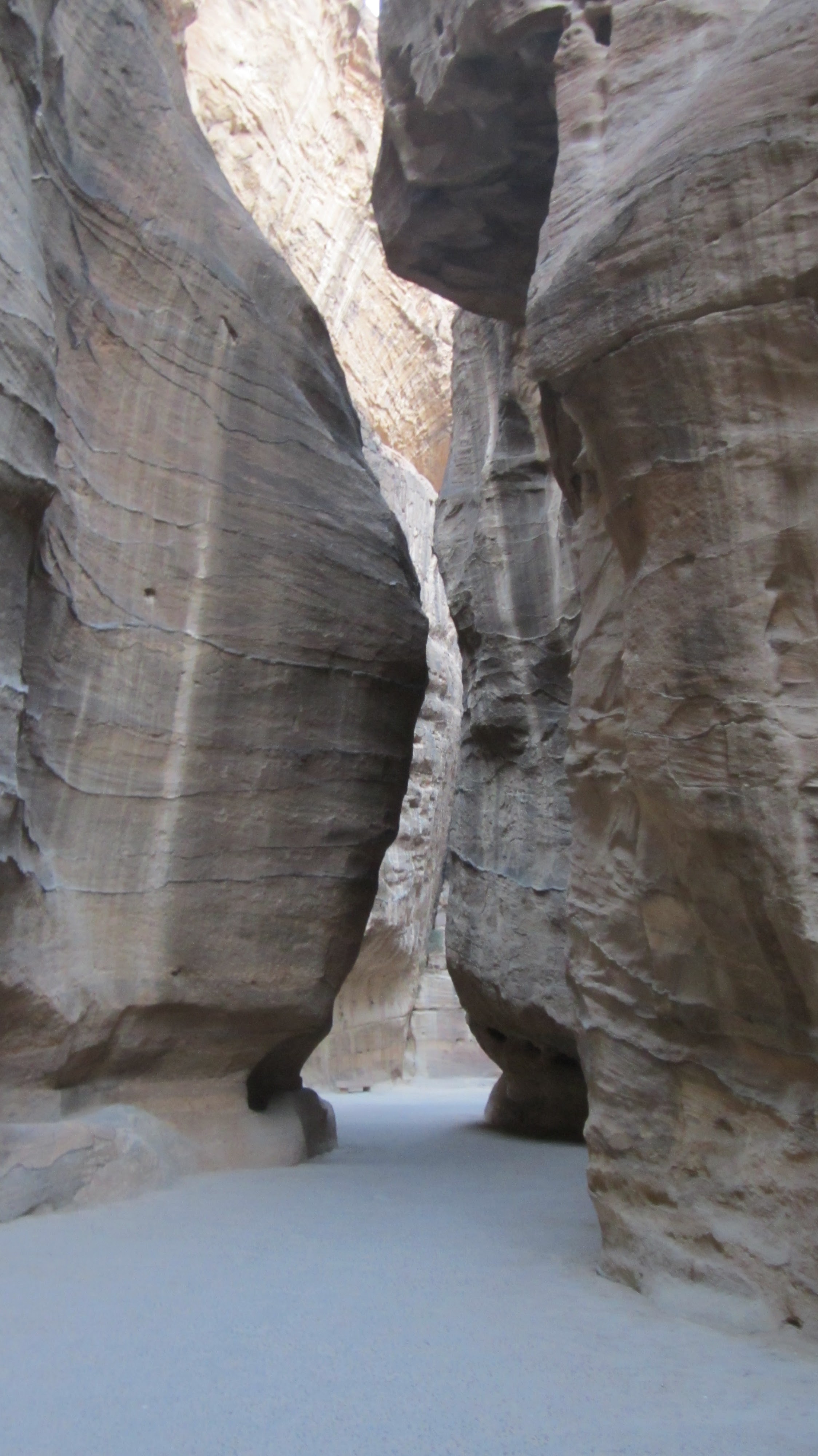
There's a pivotal moment in the movie where Indiana and Henry ride on their horses through a gap in the rocks. You hear the music play so you know something big is going to happen. The gap in the rock opens up with light and the music crescendos. 


This shot in the movie is a little bit of Hollywood trickery. The Siq - as it is called - doesn't open up to the Temple. It doesn't stop me from taking a moment to calm myself. Because this is all suddenly very real. I need to breathe because if I don't I'm going to cry.

We carry on and learn a bit more about the people who have been through here, about the Bedouins who still live here. It's all very fascinating and helping me focus. 


We learn about Petra Hajj, a gathering place of pilgrimage and worship for Muslims of the time. This was carved into the stone as a depiction of the Kaaba. Muslims would practice Hajj rites around this.

I've said it before about G Adventures and I will say it again - this is a company that really goes out of it's way to give you an unforgettable experience. Our guide stopped us at one point and gave us a geography lesson. The canyon of the Crescent Moon that Petra was carved out of was once under water. Millennia ago there was an ocean where we were standing and erosion lead us to where we were now. On days like today, if we all stand close together and stamp our feet in this very spot, we can feel the ground move because of the water. So we stamped. He told us to stamp harder. We thundered! 

Just kidding. If you look over there, that's the Treasury.

Holy. Shit. 
For a moment I could not actually breathe. This wasn't something that felt real. It wasn't happening, least of all to me. I wasn't actually here - that's not possible. I have to actually remind myself to breathe because there's no way I would do it on my own - I've proven now that I can't be trusted with such things.

I actually started crying. Because this is real. I am here. This is happening. And I've only caught a glimpse. There's more to it and I need to see every inch of it I can.


I'm still crying because this is a thing that is meaningful to me. This is the 10 year old poor kid who was picked on and didn't have a good home life, and took comfort in this place. This 10 year old never thought this was real, let alone that she would get to see it - ever. But here it is and here I am and it's so very real. And I'm here. There's that not breathing thing again.

I don't have the skill with a camera or with words to tell you about this place. About how it feels. It feels like it's from another world. You get such a sense of time and place when you look at it. You get a sense for the fact this was built in 1 BC and it apparently took far less time than you'd think. 

It was built as the final resting place of the Holy Grail a mausoleum and a crypt. It is called the Treasury due to the legends surrounding the urn on top. In reality there's nothing in the urn. Our guide tells us of markings on the building that match up with the Gregorian calendar but in reality they have nothing to do with the calendar. They're just decorations.

I manage to calm myself down. I sit on a bench and just stare at this magnificent building. I can breathe on my own without reminders. I'm not taking a lot of pictures because I want to be present. I want to take in all the things around me - the braying of the camels, the murmur of the crowd, the silence, the smells, the feel of the sand. I want to be here. This place is huge - the rocks are 39 metres tall. The space is slowly staring to fill with people but I don't care. I know this is one of the moments in my life I will never, ever forget. 

Writing this, I haven't done it justice. It's still so hard to believe that it's real and I've been there. I cannot describe the significance of this place or what I felt in these moments. This was important, this made an impact.

Wow. Woah.

Next: "802 Steps" must mean something else in Arabic.


Saturday, 18 March 2023

Lived and learned from fools and from sages

 In the land where three of the world's major religions were born, it's strange to see a church named after a saint. It's strange to see a Christian church at all. Not in a negative way of course; we've been able to set our clocks by the Adhan (call to prayer) that would ring out multiple times of the day over loud speakers and car radios. Jordan is predominantly Muslim in everything it does, so the Byzantine church of Saint George was a very different place.

Inside the church isn't much different from any other Christian church you've been in. Mostly set up like a Catholic church with the stations of the cross, a few holy water fonts, and even a crypt. Knowing the few things I know, I think if it were Catholic and not Greek Orthodox, it would more properly be described as a basilica.

Remember a while back when I spoke of pedantry? About how it is fairly inarguable that the site of Jesus' baptism was in Jordan and not Israel? This is how we know. The Byzantines who built this church were very good at keeping records, and very good at mosaics. This particular mosaic was built on the floor of a church, which was destroyed by an earthquake in 746. It was partially destroyed but much of it remained.


The map is 16m by 5m and is oriented East to West instead of North to South. In Greek, it depicts several holy sites, including that of Jesus' baptism. There are various scenes in appropriate locations - a lion hunting a gazelle in the Moab desert, for example - and serves as a guide, a jumping off point for several Christian Holy Land pilgrimages. The map's accuracy has been proven by many archaeological discoveries further a flung. 

We carried on to Kerak Castle. This castle was continually occupied for eight centuries. It's been occupied by Muslims, Byzantine, Moabites, and Ottoman. In no particular order. Wars were battle in and for this castle due to it's strategic location and excellent views. Most importantly, whoever controlled the castle controlled trade in the region, as they could physically oversee the trade routes.

Kerak Castle was a one stop shop for those who conquered it. 


                                                                        There are prison cells.


                                                                     There are barracks with balconies.

One of the reasons the castle has stood so long is physics. Well, architecture. But also physics. Arches are very strong and this castle is full of them. They were meticulously built, and were as our guide pointed out, "Muslim arches."


The difference is that arches made by the non-Muslim conquerors were not pointy.


The view was spectacular.


Next: Little rock.

Friday, 30 December 2022

Oppressed so hard they could not stand

 It has been said that on a clear day, you can see forever. 

Forever means different things to different people. Here in Southern Alberta, "forever" means being surrounded by big sky and flat prairies that dance on the wind as far as the eye can see. There are endless straight roads carving through the flat land and the foothills that are breathtaking. Time seems to stand still as you drive down these roads with fields of wheat, canola, and corn on either side of you, until you're brought to the foothills which roll into a different kind of forever. The road is still endless, it simply ebbs and flows with the remarkable vista of ranchlands morphing into forests, climbing and climbing until you're surrounded by the embrace of the Rocky Mountains. Forever shifts up then, taller, majestic, and literally breathtaking as the air thins while you climb ever higher. On a clear day the colours change from golds and ambers to verdants and emeralds, to slate grey and silver and white. 

Forever means different things to different people. In bibical times, forever meant wandering in a barren land for 40 years and staring into the Promised land. It meant punishment and longing. It meant an old man went up a mountain and died alone, staring at what he'd worked for but was banished from achieving, and eventually dying.


We couldn't see a lot, but from this spot you can see Jericho, the West Bank, and Jerusalem. On a clear day.

There is a Byzantine church at the top of the mountain. Inside this church are very well preserved mosaics that depict Byzantine customs, the history of the area, and the flora and fauna that used to be there.


These mosaics were created in the 5th century BCE. They were rediscovered starting in 1933 and were preserved by not being found for so long. The Byzatines were really good at making mosaics and when they were built over/buried by time, no one really thought more about them.

Atop the mountain is a sculpture called the Brazen Serpent.


Arguably representative of either caduceus or the rod of Asclepius. Either way it was built to stand as a visual of the serpent on a staff that Moses used to protect people from deadly plagues. Basically, it's a giant vaccine. 

Mount Nebo stands out in Jordan as the custodians are Franciscan monks,  not Jordanians. Monks from all over the world come to do monk things here and care for the lands. This is the first place I've ever seen a monk! He was taller and had more hair than I expected, and was using a cell phone. He was also a lot younger than I had expected. I didn't get a picture because it felt wrong (also I was drinking coffee which was a little more important to my addicted self). 

Next: pedantic maps and a castle that could cause a riot.


Monday, 21 November 2022

Baptise me in your love

 Those that know me know that I love a bit of pedantry. I especially love pedantry with deep historical roots to quietly have in place while one side yells and screams and is proven wrong if they simply looked with their eyes at what is plain in front of their face.

A new layer to the pedantry I admire so much: add Pope John Paul II. That's right - one side called in dad. 

I bring you the Site of Jesus' baptism.

"But Jesus wouldn't approve of the pedantry!" you say, probably clutching your pearls.
You're wrong, I say. Jesus loved pedantry. Do I need to remind you about the ten commandments and what happens to those who disobey? Also Leviticus. Also Exodus. Also Revelations. Also most of the bible.

The pedantry in question dates back to the Madaba mosaic map from the 6th Century AD. This map places the site where John the Baptist lived on locusts and honey until Jesus came to be baptised by him in an area described as "Bethany beyond the Jordan".  This has stood as being accepted and canon for eons until a re-drawing of borders in 1994 and Israel decided it was on their side of the River Jordan. Millions of pilgrims of several religions over millions of years disagree, but you do you Israel.
 
We arrived at the site and it isn't anything spectacular. There are churches along the way and so, so many flies. The path to the actual site is nice and shaded, which is a welcome change. There has been a modest amount of money put into this effort, something Jesus would approve of.  The actual side is cordoned off and - most importantly for pedants - is set back from the river, or is "beyond the Jordan", as the bible words it.
 

 The argument between where it is officially has raged on and on between Jordan and Israel. The area was in a heavily militarized zone until 1994. After it was demilitarized more evidence was found that pointed to this being the actual site where Jesus was baptised. In 2000, Pope John Paul II came to visit and this made it official as far as churches and godly people are concerned.


The Pope did pope things along side King Abdullah II of Jordan and his wife, Queen Noor.

Appropriately enough, this is a mosaic. It was all done by local artisans and is absolutely amazing.

The border with Israel in this area is two meters. The actual border floats in the River Jordan. 


This is a mostly peaceful border but don't think crossing it will be easy; on the Jordan side are armed military and we're told the same is on the Israel side. Our guide also tells us how there are families - primarily Palestinians - who will stand on this dock area while their other family members stand on the other side and talk to each other over WhatsApp. They can't come closer or be reunited for various political reasons and it is kind of heartbreaking.

Not to be outdone by some humble structures, Israel has built an entire visitor's centre on the other side. On the day we visited, there were Christians playing music and being baptised.


 Millions of dollars have been spent on this site in the hopes that money will make it official but UNESCO also says Jordan is the clear winner here. 
 
Me? I'm going with UNESCO.


To give a visual example of how close these two countries are.


 Next: cows and bees and not all who wander are lost.


Friday, 18 November 2022

No looking back, no turing in to salt

 Jordan is a religiously significant area. There's no getting around this. It is significant to all three major religions in the world for various reasons. It is also fairly significant for geopolitical reasons too, but today is about religion.

Sodom and Gomorrah in the bible are generally regarded as probably not the best places. Millions of years later, here we are in 2022 with sodomy laws on the books world wide pertaining to a particular sex act. The story generally goes that these two towns were lawless and sinful, absolutely wicked. Bad in so many biblical ways. So bad, in fact, that God struck them down. The righteous were given a chance to leave and never turn back. Lot's wife turned back and became a pillar of salt, thus creating the salinity when God smashed his fist down to destroy the cities and flood them.

Or it is a result of prehistoric continuous flooding from the Mediterranean Sea along the Rift Valley and sustained by ever changing tectonics.  The salinity is more or less due to the geological make up of the area.

Y'know, dealer's choice.

Either way this was a lesson in Jaee Follows Directions. The trip notes state that at Jordan is a primarily Muslim country, one should dress conservatively. It is recommended that women bring a pair of capris and a t-shirt to the Dead Sea. This is exactly what I did. I was the only one. 

You can also cover yourself in mud from the Dead Sea that is supposed to be good for your skin. If nothing else it makes for an interesting picture.

Our first Instagrammer! This woman's long suffering companion spent 10 minutes photographing this pose and ever so slight variations.

She stopped every five or so frames to check and then went back to the same pose.

The Dead Sea is 10 times saltier than the ocean. This means two things: you are very, very buoyant, and if you've ever scratched any part of your body in your life, you will have regrets. Ask me how I know.

My buoyant self kept flipping over, so the Dead Sea nearly became very literal. My legs were stinging from where they itched last week so it was probably best I got out of the water anyway. 

 Most of our group floated just fine.
 
Next: Pedantry and the Pope.


Thursday, 17 November 2022

Hark, hear the pipes calling

 Our first day in Amman I spent mostly napping. It had been a long couple of days and apparently I needed the rest. This is fine because Day 1 on G Adventures tours is always an arrival day with nothing scheduled until later in the afternoon for our first briefing.

Because of my travel schedule, I booked an extra night. I arrive at the hotel at  probably 2330, wild-eyed and exhausted. The lobby is bright and busy. The front desk staff is very friendly and informs me I've got an upgrade and my share will be joining me. Awesome. I take this to mean that I have a better view or a quieter location. Oh no. 

We meet for our first briefing and we go out to our first dinner where we learn a few things:

1) Lemon mint is the most amazing drink ever. It is exactly how it sounds, blended together. It is perfect and tonight we have the first of many.

2) "Vegetable platter" most likely means rice, vegetables, and a lamb chop. This is not a vegetarian dish. We don't want to insult the Jordanians by asking for it without the lamb chop so we just don't order it.

3) Menus are very literal. "Platter of tomatoes" means a dish of warmed, seasoned tomatoes. That's it. Ask me how I know.

4) Pita bread is life.

 The following day we head to Jerash. This is an ancient city that reflects how a lot of Jordan is.

Over the centuries, many empires ruled this area. Neolithic, Greeks, Romans, Byzantine, and Ottoman to name a few. This place is old. It is very old. It is also not well preserved because it has no protection; despite all logic, it should be a UNESCO site. Because it is not and because history, the site remains mostly uncovered and built upon by the modern city of Jerash. Our guide lets us know that what we will see today is about 30% of what it once was. Over time the locals have pillaged the site and used the building materials (sandstone) for their own homes. It hasn't been excavated as much as it should because archaeologists are expensive, yo.

This area has a real sense of place. You get the feeling that you're somewhere important, somewhere actually ancient; not in a place that's been sanitized to look ancient. You actually feel that you're walking in the footsteps of people from 5 BCE.


The first thing we're greeted with is Hadrian's Arch. Obviously built by the Romans to honour Hadrian, the emperor of the time. 

Inside the arch we see the Temple of Zeus and the hippodrome. Apparently an episode of Top Gear was filmed at the hippodrome with some fast cars and some dude. Clearly not a UNESCO site.

Temple of Zeus.

This is not the largest temple on the site. That would be the Temple of Artemis, Goddess of the Hunt. This temple is in a much higher and more prominent spot. The people of Jerash cared more about the hunt and prosperity than they did the king of gods.


As with most Greco Roman cities, there is a plaza at Jerash. What's unique about this plaza is that it is ovular - it is designed for efficiency. You don't need to go around the entire plaza to get to where you're going. There is a north-southand an east-west thoroughfare that you can use to cut through.  Do you think I was smart enough to get pictures of this? Because I wasn't.

Further in is a theatre that can seat 5000 people. The steps up to the top are very steep - steep enough that this fat and top heavy girl needs to slide on her butt to get down. 
 
The theatre has really excellent acoustics that many concert halls and arenas could learn a thing or 12 from.


Inside the theatre is a man with the Jordanian military who walked around playing Scotland the Brave on his bagpipes. Apparently the Jordanians (and possibly by extension, all Arabs? I vaguely recall this but it was hot and I am still in awe of where I am so my listening skills aren't the best) adopted the bagpipes because colonialism. At any rate, this is the brownest person I've ever seen touch a set of bagpipes, let alone operate them.

Tomorrow: learning lessons about following directions.

Wednesday, 16 November 2022

So many destination, faces going to so many places

 This is another boring post about the actual ins and outs of travel.

I'm someone who loves airports. Genuinely. I love how they move, the energy, the life. I love all the different amenities offered in different places (and what some consider an amenity). I love the art. I love how an airport is a tiny capsule of the city you're in as if they're aware that this may be your only interaction with this city so why not make a good impression? I have cities I would like to visit simply because their airports are top notch.

SeaTac is not one of those airports. It is a brutalist hellscape. The website promises light and art and a Pearl Jam exhibit. It boasts about being the Best Airport in North America according to Skytrax. These things are all lies. I firmly believe they paid off whoever was surveyed for Skytrax. 


Navigating this airport is very difficult. There are few to no wayfaring markers or signs. There are two train loops (to be fair, the train is speedy) to get to the other side of the airport but they really lead nowhere. Finding somewhere to eat is nigh on impossible. If you want a charging port, good luck - I walked every available inch of that airport and found five. Most of the retail and dining options are in a terminal that is a 10 minute walk from the last train stop on either loop. You really earn your US $19 Impossible burger! Finding your gate is even worse - the terminals are labelled very differently from the actual gates. Thankfully the staff is helpful and seems quite accustomed to these kinds of questions. And the Pearl Jam exhibit? I think I may have found it before security but I have no idea. There was a wall with album art by a local artist that I've never seen, that all had to do with Pearl Jam. 

The flight I'm taking to Doha has an hour and a half to connect. That's not a lot of time and when we somehow lose half an hour in the air it becomes even less. I'm not allowing myself to stress out because that won't help anyone. I've been assured that there is enough time (their minimum connection time is in the neighbourhood of 50 minutes for an international flight). Breathe and trust the process.


It doesn't take long to figure out why there is such a narrow MCT - you don't get a passport stamp in Doha. If you are only transiting and not leaving the airport, you do not get a visa. Fair enough, I guess but I do love my passport stamps. A quick jaunt through security and I'm in an airport fully decked out for FIFA World Cup. It is a big and airy airport with excellent wayfaring and people movement. Efficient to a fault. Clean and somehow bright but eternally dusk at the same time. It's not long before I'm off to Amman!

I don't have a lot to say about the Amman airport. The inbound corridors are designed to keep you on a path to customs and immigration and they do a great job of that. There is a curious sign directing those coming in for medical tourism in one direction but we'll get to that eventually. The one thing I will say as a positive is that when you get into the arrivals hall there are several kiosks you can buy a sim card from. They're not fly by night places either, they're from the same mobile providers that Jordanians use every day. The pricing is unbelievably cheap and the staff is excellent. 

After China I learned that if there is an airport transfer available from the tour company (and you don't speak the language well enough/feel comfortable enough to navigate a cab), take it. I met my driver and set out for a night time drive through Amman to get to my hotel on the opposite side of the city.

Next: Holy crap I'm in Jordan.